Learn Hangul Consonants and Vowels
If you have never studied Korean before, Hangul may look unfamiliar. Several lines and circles are gathered into square-shaped blocks, and each block seems to represent a complicated symbol.
The good news is that Hangul is not a collection of random pictures. It is a writing system built on clear and logical principles. Once you understand how its consonants and vowels work together, you can begin reading Korean much sooner than you might expect.
In this beginner’s guide, you will learn:
- what Hangul is;
- the 14 basic Korean consonants;
- the 10 basic Korean vowels;
- how consonants and vowels form syllable blocks;
- why romanization is only a temporary guide;
- how to connect Hangul with words from your morning routine; and
- why Korean speakers often leave out the subject of a sentence.
You do not need to memorize everything today. The goal of this lesson is to understand the system and start recognizing its patterns.
1. What Is Hangul?
Hangul (한글, hangeul) is the writing system used for the Korean language.
Hangul was created in the 15th century under King Sejong. At that time, ordinary people found the existing writing system difficult to learn. The new alphabet was designed so that more people could learn to read and write.
This history can give beginners confidence. Hangul was not created to make reading mysterious or complicated. It was created to make written language more accessible.
In my view, Hangul becomes much easier when learners understand the ideas behind the letters instead of trying to memorize every shape without context.
Hangul and Korean are not exactly the same thing:
- Korean is the language.
- Hangul is the writing system used to write Korean.
The relationship is similar to the difference between the English language and the alphabet used to write it.
2. Hangul Is Built from Consonants and Vowels
English letters are normally written in a horizontal line:
h + a + n
Korean letters are arranged inside a syllable block:
ㅎ + ㅏ + ㄴ = 한
han
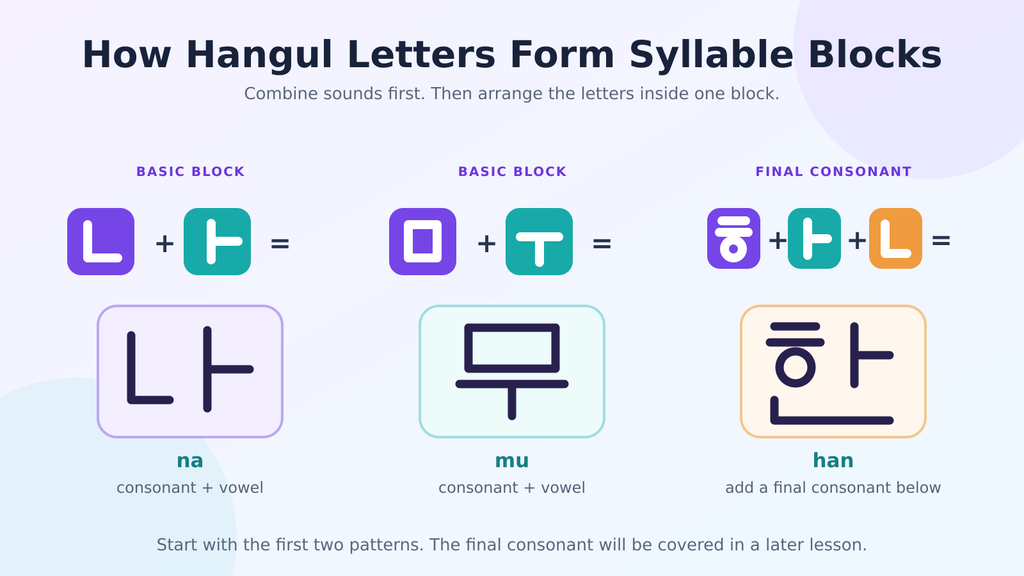
Although 한 looks like one character, it contains three individual letters:
ㅎ— consonantㅏ— vowelㄴ— final consonant
Do not worry about the final consonant yet. This is called 받침 (batchim), and it will be covered in a separate lesson.
For now, remember this basic principle:
A Korean syllable usually begins with a consonant and includes a vowel.
Here are some simple combinations without a final consonant:
ㄴ + ㅏ = 나— naㄴ + ㅓ = 너— neoㅁ + ㅗ = 모— moㅂ + ㅏ = 바— baㅅ + ㅜ = 수— su
You are not memorizing a picture such as 나. You are combining the sound of ㄴ with the sound of ㅏ.
That is the key to reading Hangul.
3. The 14 Basic Korean Consonants
Modern Korean has 14 basic consonants.
| Consonant | Approximate sound | Romanization guide |
|---|---|---|
| ㄱ | between English g and k | g |
| ㄴ | similar to n | n |
| ㄷ | between d and t | d |
| ㄹ | between r and l | r/l |
| ㅁ | similar to m | m |
| ㅂ | between b and p | b |
| ㅅ | similar to s | s |
| ㅇ | silent at the beginning; ng at the end | —/ng |
| ㅈ | similar to j | j |
| ㅊ | similar to an aspirated ch | ch |
| ㅋ | aspirated k | k |
| ㅌ | aspirated t | t |
| ㅍ | aspirated p | p |
| ㅎ | similar to h | h |
These English letters provide only approximate guidance. For example, ㄱ is not always exactly the same as an English g or k. Its sound can change slightly depending on its position in a word.
At this stage, you do not need to study every pronunciation rule. Listen to a native pronunciation, look at the letter, and repeat the sound several times.
Why do some consonants look the way they do?
Several basic consonants were designed with the shape of the speech organs in mind.
For example:
ㄴis associated with the position of the tongue when making an n-like sound.ㅁresembles the shape of the mouth.ㅅrepresents the shape of teeth.ㄱis connected to the position of the tongue when making a g/k-like sound.
You do not have to memorize these explanations perfectly. Their purpose is to show that the letters were not created randomly.
Understanding this principle can make the alphabet feel less intimidating.
4. The 10 Basic Korean Vowels
The 10 basic vowels are formed with combinations of short lines.
| Vowel | Romanization guide | Approximate sound |
|---|---|---|
| ㅏ | a | similar to “a” in father |
| ㅑ | ya | similar to “ya” |
| ㅓ | eo | a Korean vowel without an exact English match |
| ㅕ | yeo | similar to “yuh,” but not identical |
| ㅗ | o | similar to “o,” with rounded lips |
| ㅛ | yo | similar to “yo” |
| ㅜ | u | similar to “oo” in moon |
| ㅠ | yu | similar to “you” |
| ㅡ | eu | a Korean vowel without an exact English match |
| ㅣ | i | similar to “ee” in see |
Pay particular attention to these vowels:
ㅓ— eoㅡ— eu
The spellings eo and eu do not tell you exactly how these vowels sound. They are romanization conventions, not instructions to pronounce two separate English vowels.
Listen to the real sounds and imitate them. Romanization should help you begin, but it should not replace listening.
Important: Romanization is a map, not the destination. Use it briefly to identify a sound, and then learn the sound by listening to Korean.
5. How Do Korean Letters Fit Together?
The direction of the vowel helps determine the shape of the syllable block.
Vowels with a vertical shape
When a vowel has a vertical form, it is generally placed to the right of the consonant.
ㄴ + ㅏ = 나— naㄱ + ㅓ = 거— geoㅁ + ㅣ = 미— mi
Vowels with a horizontal shape
When a vowel has a horizontal form, it is generally placed under the consonant.
ㄴ + ㅗ = 노— noㅁ + ㅜ = 무— muㄱ + ㅡ = 그— geu
The letters change position, but their basic sounds remain connected.
Try reading these slowly:
나 — 너 — 노 — 누 — 느 — 니
na — neo — no — nu — neu — ni
Then try another consonant:
마 — 머 — 모 — 무 — 므 — 미
ma — meo — mo — mu — meu — mi
You do not need to read quickly. Look at the consonant, find the vowel, and combine their sounds.
6. Why Is ㅇ Sometimes Silent?
A Korean syllable needs a consonant position, even when its spoken sound begins with a vowel.
In that situation, ㅇ is placed at the beginning of the block and is silent.
For example:
ㅇ + ㅏ = 아— aㅇ + ㅓ = 어— eoㅇ + ㅗ = 오— oㅇ + ㅜ = 우— uㅇ + ㅣ = 이— i
At the beginning of these blocks, ㅇ has no sound of its own. It provides the consonant position needed to build the syllable.
Later, you will learn that ㅇ can sound like ng when it appears at the end of a syllable. That belongs to the lesson about final consonants.
7. Learn Hangul Through Your Morning Routine
Learning letters is important, but letters become easier to remember when they are connected to objects and actions you encounter every day.
Imagine an international Korean learner standing in a bathroom after waking up. Around the learner are familiar objects used every morning.

Here are some useful bathroom words:
| Korean | Romanization | English |
|---|---|---|
| 비누 | binu | soap |
| 칫솔 | chitsol | toothbrush |
| 치약 | chiyak | toothpaste |
| 수건 | sugeon | towel |
| 거울 | geoul | mirror |
| 면도기 | myeondogi | razor |
| 세면대 | semyeondae | sink |
| 샤워기 | syawogi | shower head |
Some of these words contain final consonants or vowels that have not been covered in this first lesson. That is all right.
Treat them as a preview. Look at the object, listen to its Korean name and repeat it. You do not need to analyze every letter yet.
For your first week, focus on only five words:
- 비누 — binu — soap
- 칫솔 — chitsol — toothbrush
- 치약 — chiyak — toothpaste
- 수건 — sugeon — towel
- 거울 — geoul — mirror
Now connect the objects with actions:
- 세수해요.
Sesuhaeyo.
I wash my face. - 양치해요.
Yangchihaeyo.
I brush my teeth. - 샤워해요.
Syawohaeyo.
I take a shower. - 거울을 봐요.
Geoureul bwayo.
I look in the mirror. - 수건으로 닦아요.
Sugeoneuro dakkayo.
I dry myself with a towel.
You may not understand every grammar point in these sentences yet. For now, connect the words, sounds and actions.
When you pick up your toothbrush, say:
칫솔. 양치해요.
Chitsol. Yangchihaeyo.
Toothbrush. I brush my teeth.
Repeating a short expression during a real action can make it easier to remember than studying an isolated vocabulary list.
8. Why Is the Subject Often Missing in Korean?
English sentences normally require an expressed subject:
I wash my face.
Korean can also include a subject:
저는 세수해요.
Jeoneun sesuhaeyo.
I wash my face.
However, Korean speakers frequently leave out the subject when it is already clear from the situation.
세수해요.
Sesuhaeyo.
Depending on the context, this may mean “I wash my face,” “I am washing my face,” or refer to another understood subject.
The missing subject does not make the Korean sentence incorrect. Korean communication often relies on shared context. Speakers do not need to repeat information that both people already understand.
Compare these forms:
| Korean | Romanization | Meaning |
|---|---|---|
| 저는 세수해요. | Jeoneun sesuhaeyo. | I wash my face. |
| 세수해요. | Sesuhaeyo. | I wash my face—the subject is understood. |
| 저는 세수했어요. | Jeoneun sesuhaesseoyo. | I washed my face. |
| 세수했어요? | Sesuhaesseoyo? | Did you wash your face? |
| 저는 세수할 거예요. | Jeoneun sesuhal geoyeyo. | I will wash my face. |
| 저는 세수합니다. | Jeoneun sesuhamnida. | I wash my face—in a more formal style. |
You may also see 나는 (naneun), which means “I” or “as for me.” It is generally more casual than 저는 (jeoneun).
- 나는 세수해요. — Naneun sesuhaeyo.
- 저는 세수해요. — Jeoneun sesuhaeyo.
Both are possible, but 저는 is the more polite and respectful choice when speaking to someone you do not know well, someone older than you, or someone of higher social or professional status.
What about 당신?
A sentence such as this is grammatically possible:
당신은 세수했어요?
Dangsineun sesuhaesseoyo?
Did you wash your face?
However, Korean speakers often avoid using 당신 as an everyday equivalent of the English word “you.” Depending on the relationship and situation, it can sound unnatural, distant or confrontational.
Instead, Korean speakers may:
- leave out the subject;
- use the person’s name;
- use a title or family term.
For example:
- 세수했어요? — Sesuhaesseoyo?
- 민수 씨, 세수했어요? — Minsu-ssi, sesuhaesseoyo?
- 엄마, 세수했어요? — Eomma, sesuhaesseoyo? — Mom, did you wash your face?
In my view, beginners should not try to force every Korean sentence into the English pattern of subject, verb and object. Observe the situation and notice what the speakers already know. This will help Korean sentences feel more natural.
9. A Seven-Day Hangul and Morning Korean Challenge
Use the same words and expressions for one week. A short daily routine is more useful than trying to memorize a long list at once.
Day 1: Look and listen
Look at the five bathroom objects and listen to their Korean names. Repeat each word slowly.
Day 2: Point and speak
Point to each real object in your bathroom and say its Korean name.
Day 3: Connect words with actions
Say 세수해요 (sesuhaeyo, “wash my face”), 양치해요 (yangchihaeyo, “brush my teeth”), and 샤워해요 (syawohaeyo, “take a shower”) while performing or imagining each action.
Day 4: Read simple syllables
Review combinations such as:
나(na), 너(neo), 노(no), 누(nu), 마(ma), 머(meo), 모(mo), 무(mu)
Identify the consonant and vowel in each block.
Day 5: Add a greeting
When you meet someone in the morning, practice one short expression:
- 안녕하세요. — Annyeonghaseyo. — Hello.
- 잘 잤어요? — Jal jasseoyo? — Did you sleep well?
Day 6: Describe your morning
Try saying three short expressions in order:
세수해요. 양치해요. 거울을 봐요.
Sesuhaeyo. Yangchihaeyo. Geoureul bwayo.
Do not worry if the pronunciation is not perfect.
Day 7: Return and review
Come back to this lesson. Cover the English meanings and see how many words you remember.
Use this checklist:
- I can recognize several basic consonants.
- I can recognize several basic vowels.
- I understand that Korean letters form syllable blocks.
- I can say at least three bathroom words.
- I can use
세수해요and양치해요. - I understand that Korean subjects can be omitted when the context is clear.
10. Do Not Depend on Romanization for Too Long
Romanization can help you take your first step. It can show that 나 is read approximately as na and that 무 is read approximately as mu.
However, Korean and English do not use exactly the same sound system. A romanized spelling cannot fully represent Korean pronunciation.
A useful learning order is:
- Look at the Hangul letter.
- Listen to its Korean pronunciation.
- Watch the speaker’s mouth if possible.
- Repeat the sound aloud.
- Use romanization only when you need a temporary reminder.
- Gradually read the Hangul without romanization.
Making imperfect sounds is part of learning. The goal is not to wait until your pronunciation is flawless. The goal is to listen, try, compare and improve.
Final Thoughts
Hangul may look different from the alphabet you already know, but its structure is logical.
Begin with three ideas:
- Hangul contains consonants and vowels.
- The letters are arranged into syllable blocks.
- Understanding and using the letters is more effective than memorizing them without context.
Do not try to master every consonant, vowel and pronunciation rule in one sitting. Learn the basic principle, practise a few combinations and connect Korean with the objects and actions in your daily life.
Tomorrow morning, look around your bathroom. Pick up your toothbrush and say:
칫솔. 양치해요.
Chitsol. Yangchihaeyo.
That small action is already a meaningful beginning.
In the next lesson, we will learn more about double consonants, combined vowels and final consonants called 받침 (batchim).